Learning to drive and sharing the road
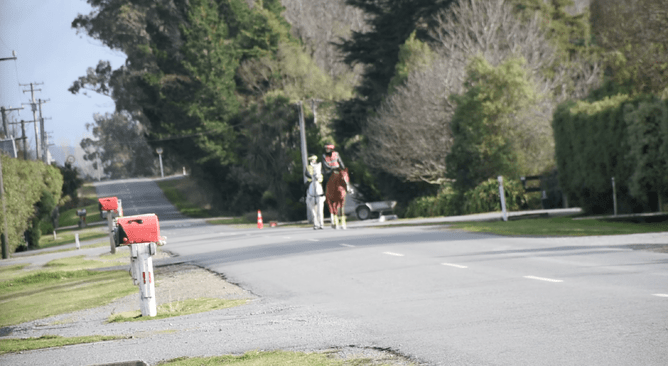
Just over 50% of people in New Zealand live in one of the seven major cities. The chance of coming across a horse on the road in the city is fairly slim - in my 30+ years of living here, it’s only happened once for me (on Waiheke Island which, while technically part of Auckland, is an anomaly). However, when I have driven out of Auckland, it has happened more times.
Are we preparing our drivers in cities for dealing with horses on the road? Are we taught much about sharing the road with horses when we learn to drive? Probably not. What does the current learning-to-drive regime contain about horses?
The Road Code
The Road Code has the basics about it on page 169, covering general courtesy, speed and passing distance, passing a horse at night and the implications of driving inconsiderately around horses (i.e. being charged with careless or dangerous driving).
The LSFDI
The LSFDI (Learning Systems for Driving Instructors) is a publication that driving instructors use to help them teach students to drive. It has sample lesson plans. There’s nothing in the two lesson plans (17 Rural/open road driving and 18 Night driving) which would be most relevant to talk about horses on the road. Lesson 17 mentions stock on the road; perhaps horses are to be included in this as a ‘catch-all’.
Driving instructors can change or augment these lesson plans (they’re a starting point), but horses are easily spooked, so driving awareness of this would be an important point.
Learner Licence Test
The questions you get asked for in the learner licence test have nothing related to horses. This test is used both for new drivers who might take driving lessons, but also for drivers who have moved to New Zealand from overseas who are required to take a theory test to convert their overseas licence.
What about other experiences of driving?
We mentioned overseas drivers, many of whom will have experienced horses and other animals on the road. I’ve had the pleasure of driving in a variety of countries (UK, Australia, Italy, Iceland, Fiji, etc) and one thing prey animals have in common is running in the wrong direction, often down the road as they try to escape. The issue with a horse is it has the potential to throw the rider into the path of other vehicles.
Whether a driver has experienced horses on the road, or been taught about it, though, is uncertain; those moving from crowded cities may never have driven around large animals.
So, what could (or should) be done about this?
NZTA has produced some social media content, and occasionally there is other media visibility for the challenges of driving around horses (not including the unfortunate cases when a rider is killed or injured and it’s in the news). There should be more variants of this message.
Any information and training material should follow best practices from industry experts.
Driving instructors should include information about driving around horses in their lesson plans (albeit we have to acknowledge that not all learners use a driving instructor).
Legislation should ensure that penalties are appropriate for driving inconsiderately around horses.
Horse riders must also take the responsibility to understand the driver’s point of view so that they are not inadvertently putting themselves at more risk than is necessary, for example, by clearly signalling intentions, wearing appropriate PPE, etc.
Ultimately, we’re dealing with an animal controlled by a fallible human; there’s no way to create zero risk if horses share the road with vehicles. However, we can create risk that is just extremely low by ensuring that the right training and information is available to drivers of all ages and abilities.
Darren Cottingham is a driver trainer who founded DT Driver Training (now part of TR Group).
Julia McLean wrote to NZTA regulatory when she learned that “There is nothing in the two lesson plans (17 rural/open road driving and 18 night driving) which would be most relevant to talk about horses on the road. Lesson 17 mentions stock on the road: perhaps horses are to be included in this as a ‘catch-all’."