The Vulnerable Road User Submission was submitted to New Zealand Parliament’s Select Committee - Transport and Infrastructure in November 2024. As the author I was invited to speak to the Submission and provide further evidence.
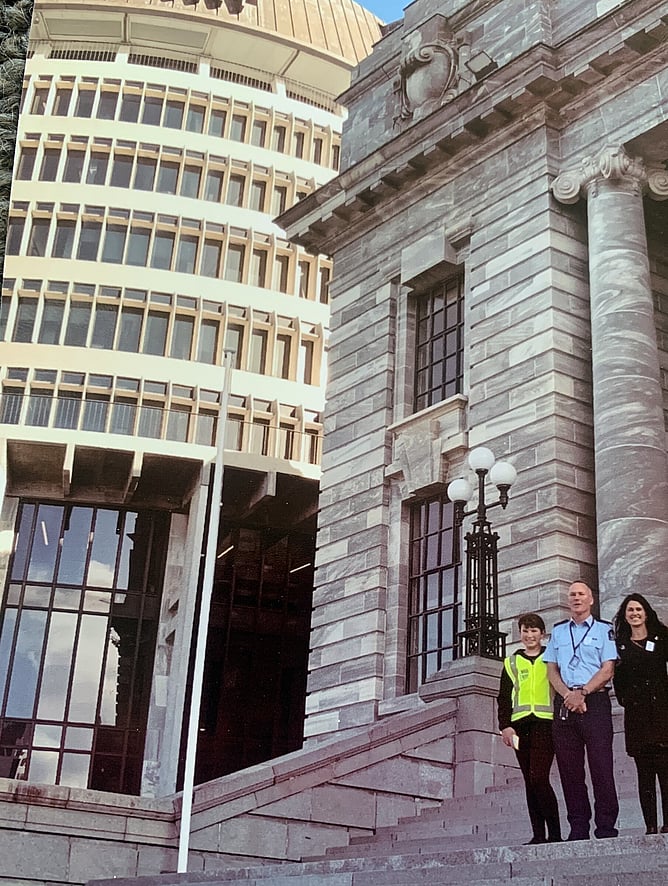
In June 2025, my daughter Delia and I travelled to Wellington and presented in person thanks to the support of New Zealand Thoroughbred Welfare and Harness Racing New Zealand. All this work is voluntary, so my family appreciated this support.
We used the opportunity to meet with Inspector David Martin, Rural Policing at NZ Police National Headquarters. It was important to me to thank NZ Police for endorsing and supporting the Pass Wide and Slow road safety message.
Inspector Martin surprised us and attended the Parliamentary presentation. No pressure!! He was invited by Committee Chair Andy Foster to sit at the table. In all seriousness, it was great to see NZ Police taking the issue of equestrian road safety seriously and attending to listen to the case.
We were appreciative of the time given to us to present and the welcoming environment that we walked into. All politicians were very friendly and were particularly impressed to have a 13-year old stand before them.
Delia outlined why horse riders must be formally recognised as a Vulnerable Road User. It was a three-minute speech she wrote and delivered to her primary school class before being asked to present it at a district competition where she came 2nd. The same speech was delivered to Canterbury Mayors and Chair at the Regional Transport Committee where we secured unanimous support for equestrians to be formally recognised as Vulnerable Road Users in Transport Legislation.
This speech has also been subsequently shared with the lead of NZTA's Crash Analysis System who described it as a "fair summary" and who asked my permission to send it on to the Ministry of Transport. Of course, I said "absolutely"
Kia Ora Members of Parliament.
My name is Julia McLean. I am Delia’s mum and the author of the submission before you.
I am the spokesperson for this work and am speaking on behalf of Equestrian Sports New Zealand, Te Hapori Hoiho, NZ Riding for the Disabled, New Zealand Pony Clubs Assn, The New Zealand Equine Health Assn, Equine Welfare and Ethics, New Zealand Thoroughbred Racing, Harness Racing NZ, NZ Rodeo Cowboys, NZ Horse Network, NZ Ambulance Trust, the Gattung Foundation, the ANZAC Mounted Equine Rehab Unit and the Cycling Action Network to name a few. I am speaking as the founder of Pass Wide and Slow New Zealand.
I am a trained journalist and my approach to this work and case before you has focused on gathering the facts. To do this I have spoken with professionals in the respective authorities, written Official Information requests, spoken to and listened to 100s of riders road riding accounts across NZ and researched what other countries are doing. I have spoken directly with advocates in those respective countries – Victoria – Animal Care Australia, Western Australia Horse Council, UK Pass Wide and Slow founders, Northern Ireland, the British Horse Society and Colorado Equestrians.
My hope is the additional evidence submitted leaves you in NO DOUBT that the issue of formally recognising equestrians as Vulnerable Road Users in this country’s transport legislation is critical to saving lives. It is not acceptable to have a section of community not provided for by way of road safety education, messaging, the licensing system, inclusion in off-road infrastructure and publicly accessible spaces and places.
I have attempted to leave no stone unturned, and my motivation to delve deeper is because of my shock and dismay at the system as it stands. Current legislation is NOT fit for purpose.
43 lives have been lost on our roads since 2000.
40 people aged between 10 and 79yrs of age died between 2000-2019 and there’s an even split between men and women.
The Ministry of Health uses a range of sources (Police, funeral director, coroner, hospital records) to validate its data reliability and deaths are not just related to a vehicle verse car, but include all on road incidents.
There is a specific CODE for Animal Rider or occupant on a horse drawn vehicle injured in a transport accident and data MEETS International Statistical Classification. Data is released every six months.
My request is that these statistics are included in the Ministry of Transport’s data gathering, alongside the CAS system – so the Minister of Transport has a comprehensive understanding of what is happening on our roads.
As it stands
WORKSAFE has three road riding fatalities recorded in 2022. I was only allowed to obtain stats for a four year period. 2020-2024.
Meanwhile ACC has a total of 17 fatalities on its books for the period of 2007 to 2024. It stated though that its data is based around claims and voluntary reporting. It acknowledged data may not represent the total number of fatalities relating to accidents. I wish to thank ACC for suggesting I contact MoH.
NZTA meanwhile uses the Crash Analysis System (CAS) and collects three types of fatalities involving horses. Equestrian deaths Driver deaths Passenger deaths
As a result, NZTA stats show 8 equestrian deaths from fatal crashes between 1980 – 2024
The Ministry of Transport’s Crash Analysis System only captures road crashes that involve a vehicle. And yet that data informs policy, design of road safety initiatives, supports funding applications, allows staff to monitor and evaluate safety measures, support research and provides public stats. It’s the foundation for life saving work.
CAS does not capture if a vehicle spooks a horse and the rider subsequently falls and dies. “close calls” are not captured-because “they are difficult to verify and can be subjective”
And here’s where it gets messy.
NZTA manages CAS BUT relies on Police for data following their investigation into a vehicle crash
In my OIA to Police it stated death and serious injury statistics involving horse riders are held by NZTA and it tried to refer the request. However NZTA stated that it does not hold data on what type of animal is involved in a crash.
Consequently, no data could be provided by POLICE on the number of complaints made relating to road riding incidents. There is no CODE for events involving a horse and rider.
No data could be retrieved on the number of careless driver offences or death and serious injury but Police could tell me that a total of 13 $55 infringements for drivers who fail to exercise due care to a ridden or driven animal have been issued in 13-yrs.
This is the same infringement the previous and current Transport Minister publicly refer to as ‘protection in current legislation’.
In my mind NO DATA equals NO IDEA of what is happening on the road.
We welcome a review of traffic offence penalties but I would also argue it’s not necessary in this case. There is provision in legislation, it just needs to be enforced. .
Section 40 – operating a vehicle in a manner liable to cause damage/ injury or annoyance carries a $600 fine. This could cover off many of the driver behaviours equestrians sadly encounter on the road and send a deterrent. Proof can be sounding of a horn, witnesses, injury or footage.
I have written to Police to express my concern around a lack of data and made suggestions on how it can be approved. I sought advice and suggested a tick box is included on an incident report card for when police attend a complaint.
Its response was that Police do not have the capacity or resource to collect additional data or make changes to the system, but it did acknowledge it was open to any future EVIDENCE OR DEVELOPMENTS that may WARRANT a reassessment. I hope this is THAT time.
Vulnerable Road User status support
I’m thrilled to be able to tell you that equestrians have 100% support from Local Govt Regional Transport Committees. They are;
Auckland Transport Board
Auckland Regional Transport Committee (RTC)
Bay of Plenty RTC
Waikato RTC
Greater Wellington RTC
Gisborne RTC
Northland RTC
Hawkes Bay RTC
Horizons RTC
Tasman/Nelson RTC
Canterbury RTC
West Coast RTC
Taranaki RTC
Otago/ Southland RTC
All letters or confirmation of support have been tabled, and I must thank the sector for its unequivocal support and leadership.
The Licencing System we can confirm what we already know because we can see and feel it on the roads, and that is.
The lesson modules for Driving Instructors – all 20 – do not refer to a horse and rider
PWASNZ has fed into a NZTA review of these lesson plans, in particular – rural and open road driving where horses are not mentioned.
The Learner licensing test - questions asked in this have nothing relating to horses. The test is used for both new drivers and also drivers who have moved to NZ who require a theory test to convert their overseas licence.
The Road Code has the basics that cover general courtesy, speed and passing distance, passing a horse at night and the implications of driving inconsiderately around horses.
When there is no road safety messaging or education campaign on how to approach and pass a horse, for years if not decades, then in my mind it makes equestrians the MOST vulnerable road user group on the road. The road riding stories I have shared with you are a sample. Incidents of near misses, serious injury or behaviours that are careless or deliberate are prevalent everywhere.
I raised this issue with NZTA in April 2024 but it wasn’t until April 2025 that the equestrian community saw four social media posts released. It took the former Transport Minister to make enquiries on behalf of PWASNZ and NZTA told the Minister it only releases campaigns and publishes social media content at times that it would have the most impact. The Summer months were noted.
Before the end of the financial year, NZTA released its campaign. The message was closely aligned with PWAS but it didn’t quite say it.
I wrote to NZTA and requested a face to face. This was positive, but it’s absolutely clear that NZTA is hamstrung in what it can and can’t do as a result of the Government’s Policy Statement on Land Transport and expectations which set funding priorities.
The issue of getting a road safety post on the roading authority’s platform is illustrative of the battle.
That GPS position is also the same for ACC
Lost Access
We find horses displaced from historical bridle trails, banned from reserves and beaches, ousted from Crown forests and excluded from pathways and trails that enable VULNERABLE ROAD USER groups to have a safer off-road journey. Lost Access, Lost Safety
Crown entity - Herenga a Nuku - in its evidence to a 2022 Petitions Committee stated that the default policy for public access to trails should be multi-use to allow people who walk, bike, horse ride to enjoy the outdoors. If modes of use are restricted, then clear evidence should justify that decision and alternative public access should try to be identified for the excluded group.
I suggest The Walking Act that the Walking Access Commission operates under, is reviewed with a lens that is inclusive of all passive recreational users.
Advocacy in community – Equestrian’s Advocacy which is a voice for Canterbury and West Coast riders has submitted and presented to every council’s Long-Term plan last year, and recently Waimate. We are experiencing inclusion by way of 10-year strategies for Walking and Cycling NOW providing for Horse Riding. One district has allocated $150,000 for horse trial infrastructure improvements.
However, in Tasman horse riders are suddenly challenging a proposal to exclude access to stopbanks in Waimea Park for riders only.
And in Taranaki equestrians are challenging the rationale of restricting access to horse riders on the beach as part of a bylaw review. Rightly so, they are asking for evidence to illustrate there’s a problem.
Members of Parliament, like Delia said – horse riders must be formally recognised as Vulnerable Road Users in Transport Legislation and respectfully included in community infrastructure and road safety programmes.
Thank you
Note - following this presentation I learned of another road riding fatality.
In September 2025 I resigned from PWASNZ and the social platforms closed.
In November the New Zealand Vulnerable Road User Charitable Trust was established, recognising the need to create a permanent road safety platform to advocate, educate and promote being seen on the road on behalf of all VRU's.