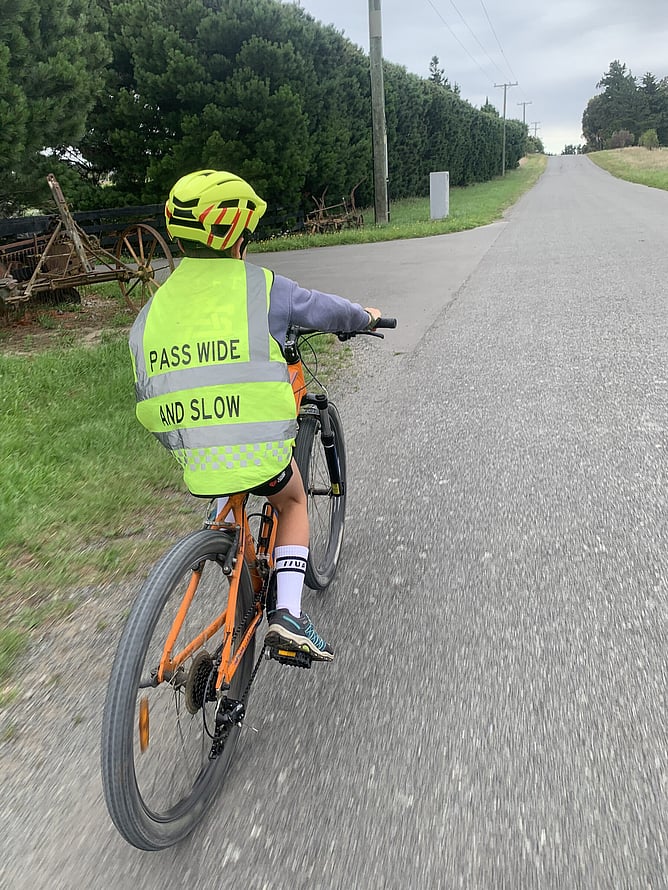
“Keep death off the road, ride on the footpath”
This was a statement made by an elderly man over a decade ago as I rode my bike on the road with my two young children. It’s a statement I’ve never forgotten because I hadn’t thought of it exactly like that, but in my mind, he had a valid point.
Now I have learned that it is illegal for children (six-years and under) to ride their bike on the footpath in this country. I’m clearly not the only one that isn’t educated, as a survey of children shows 86% have ridden on a footpath and were unaware it is illegal to do so. This survey is referred to in the Ministry of Transport’s Regulatory Impact Statement (RIS) that covers off the pros and cons of the five proposals currently out for public consultation.
Three Rule Change proposals directly affect the safety of vulnerable road users – walkers, cyclists and horse riders - in community.
They are looking at
Allowing children 12-years and under to ride their bike on the footpath
Establishing a mandatory passing gap for when motorists pass other road users, like cyclists and horse riders.
And allowing people to ride E-Scooters in cycle lanes
Let me just say, public feedback will be informed by ‘common sense’ and lived experience because much of the data specific to the issues identified does not exist. This is around micro-mobility, walking, giving way, passing distances and related injuries.
A Quality Assurance Panel which assesses the Regulatory Impact Statement to ensure there is an identified issue, stated that there are “some limitations in the availability and currency of data and research to evaluate the problem identified, but nevertheless the evidence presented supports the recommendations.”
This consultation is effectively in response to community saying for some time now, we have a problem.
Much of the case is informed from public feedback surrounding the 2020 Accessibility Streets package.
Here is what data exists? ACC data surrounding cyclist injuries doesn’t differentiate the road and the footpath, they are recorded as the same area, but what it does show is children between the ages of 10 and 14 made up the highest injury claim group on bikes.
Crash Analysis Data (CAS) – which are incidents investigated by Police and recorded by NZTA - show that in 2024 there were 9 fatal crashes, 149 serious injury and 459 minor injury crashes where cyclists were involved. Before March 2025, cyclists aged 12 and under were recorded as pedestrians.
Please NOTE – CAS data does not include near misses or minor injuries, this applies for passing distances too.
The preferred option is for cyclists under the age of 12-years to be allowed to ride on the footpath, and it acknowledges that a child’s ability to accurately judge traffic speed and movement isn’t fully developed until around this age.
The analysis also felt this age was an appropriate limit when also addressing concern around additional risk or injury to vulnerable users like people who are blind or use a wheelchair.
Existing speed and behaviour guidance is deemed appropriate – “use ‘vehicles’ (bike) in a responsible manner and to give way to other footpath users.”
Mandatory passing gap for cyclists, horse riders, pedestrians on the roadside, transport and mobility device users.
What’s the problem? Frankly, despite there being guidance, offences and penalties for unsafe passing, people continue to be seriously injured or killed.
The proposed solution?
In a speed limit zone of 60km/hr or less the minimum overtaking distance would be 1-metre
In a 60km/hr or more zone, the minimum passing distance would be 1.5m-metres
A new offence and financial penalty for breaking the rule. $300 infringement or $1500 court-ordered fine.
The above passing distances are considered appropriate because:
Rider comfort and safe distance from lateral pull force of air from a vehicle passing in a 50km/hr is predicted to be 1-metre
It takes into account the safety of the road user and other road user ability to pass safely
A greater passing distance was considered but it was considered not to be practical or an efficient use of the road.
The distances are consistent with existing guidance, and this helps with public understanding and enforcement
Reduces regulatory complexity and enhances awareness
In line with Australia
A graduated minimum overtaking gap approach is based on research carried out for cyclists in 2016.
Did you know that the current statistical value on a life is measured at close to $15-million dollars, and the average social cost of a fatality, serious or minor injury is $860,000.
It’s here that I would encourage you to visit the Trust website - you will find the number of people killed whilst walking, cycling or riding a horse in New Zealand. These Health NZ statistics are sobering and illustrate how much work we have to do as a community to reduce trauma on our roads.
Pass WIDE and SLOW