Raising a concern around any road safety issue should be viewed positively.
Raising an issue about a Temporary Traffic Management (TTM) site after you’ve just peddled through for dear life, should be taken seriously by people in positions of authority.
The NZVRU Trust asked Traffic Safe New Zealand for advice around how to raise a safety concern if you witness or experience unsafe practices at a Temporary Traffic Management (TTM) site.
Here is an outline of options available to you.
Raise the concern directly with the onsite STMS (Site Traffic Management Supervisor) — typically the person managing the site in high-visibility clothing. Anyone who identifies a potential risk is entitled to raise it, and the STMS is responsible for acknowledging and mitigating that risk where practicable.
Contact the traffic management company responsible for the site and report the concerns and safety risks observed.
Contact the local council and request to speak with the Traffic Management Coordinator (TMC) regarding the concerns.
4. Another suggestion is that where vehicles are known to speed through temporary speed limit areas — particularly around sites involving vulnerable road users — the presence of a Police vehicle on-site may provide an additional deterrent and encourage drivers to reduce their speed. You can call *555 for police assistance with any non-emergency traffic issues. Advice ends.
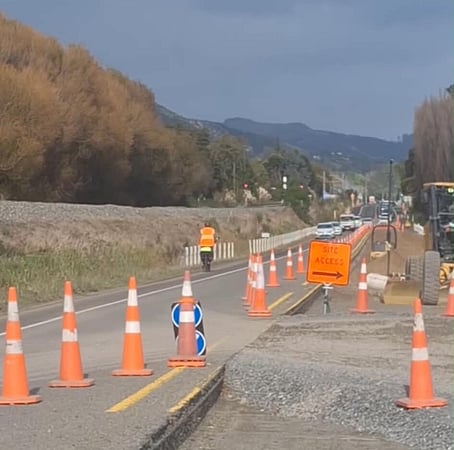
What are examples of an immediate life-safety hazard;
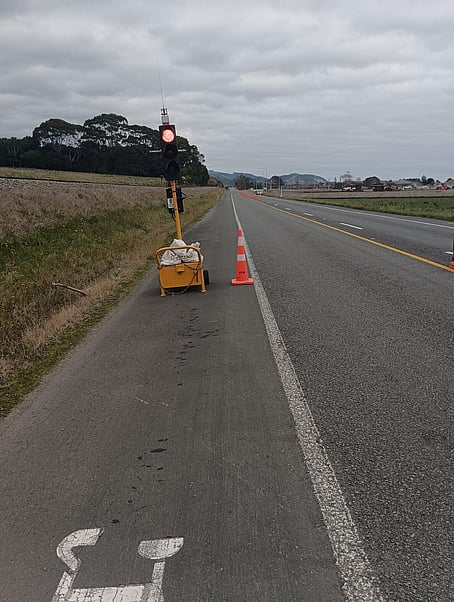
- a portable traffic light blocking a cycle lane
- a situation that creates a “head on” where either the site operators or mobile timed lights prematurely release traffic in a single lane before the traffic has cleared. For a vulnerable road user like a person riding a bike, this is a recipe for a fatal squeeze.
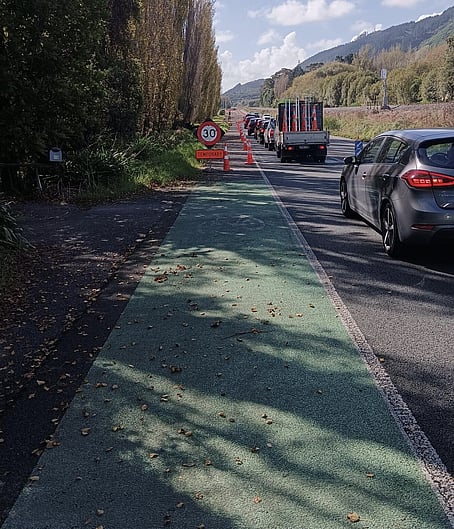
- Control of speed passing through – sites are 30km work zones.
These equate to a High-Risk Traffic Management Failure.
What do we know about TTM sites for Vulnerable Road Users (VRUs)?
There is increased severity of injury involving bicycles, pedestrians and motorcycles because of the loss of protective infrastructure (like cycle lanes) and the "squeezing" effect of temporary barriers.
Excessive speed by passing traffic increases the risk of fatality or serious injury for people riding bikes.
Currently New Zealand operators are transitioning from the old CoPTTM, which is considered prescriptive, to the new NZGTTM which is risk-based, "think about the site". If you witness or experience an immediate life-safety hazard as outlined above, you will know that vulnerable road user safety has potentially been left out of the equation.
How to make a report?
1. Try contacting the Health and Safety Manager of the contractor company.
2. Report to your local council - it manages local roads and is considered the Road Controlling Authority of the TTM. If the helpdesk person is not helpful, put your concern in writing to the Chief Executive, Mayor and Infrastructure Manager. Outline the issue, attach evidence and consider requesting a copy of the Risk Control Plan around managing safe passage for vulnerable road users. Every contractor must have one. If it cannot be provided, this is a compliance red flag.
What to write? Attach a photo, for example of the mobile light in the cycle lane and state that this is a direct violation of CoPTTM Section C8.2.19, which requires that "where a cycle lane exists, the TTM must provide for the safe passage of cyclists.”
Liability - explicitly state: "I have now formally notified the Council of a life-threatening defect at this site (premature release of traffic into a one-way section). Should an accident occur involving a cyclist at this location, this correspondence serves as proof of prior notification of the hazard."
3. NZ Transport Agency (Waka Kotahi) – it sets the standards for TTM sites. Email standardsonline@nzta.govt.nz for one off concerns, or to report systemic non-compliance. It has a vested interest in ensuring the transition to the ‘risk-based’ approach isn’t resulting in unsafe shortcuts.
4. WorkSafe New Zealand is the prosecutor of TTM sites because they are considered workplaces. Under the Health and Safety at Work Act 2015, contractors have a primary duty of care to ensure that the health and safety of other persons (including cyclists) is not put at risk by their work. If a site is physically dangerous for cyclists, it is a health and safety breach. You can report a "hazardous work situation" directly on their website - WorkSafe Report a Concern or email info@worksafe.govt.nz
5. The Ombudsman - if you feel your local council has not followed a fair process, ignored evidence or minimised your complaint, you can lodge a formal complaint against the council's administrative conduct.
When writing to WorkSafe, NZTA, or a local authority - use their language. For example, the site creates a "significant risk of harm" due to "failure to provide safe passage for vulnerable road users," which is a breach of the PCBU’s (Person Conducting a Business or Undertaking) duty of care.
We hope this information provides clarity around how to raise a road safety concern using proper process. There is nothing worse than there being a safety issue in community and people either not knowing where to report it or given the run around.
The safety of all road users involves all of us. Accountability. Responsibility. Responsiveness.
Engage in proper process to effect change!