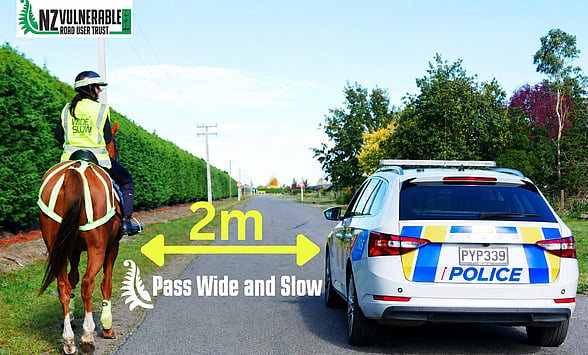
Dear Transport Minister, Chris Bishop,
I am writing on behalf of the New Zealand Vulnerable Road User Charitable Trust (NZVRU Trust) to express our concern regarding the proposed mandatory minimum overtaking distance of 1.5 metres for vehicles passing horse riders.
While we support efforts to provide greater clarity for motorists and improve safety for vulnerable road users, we believe that applying the same minimum passing distance to both cyclists and horses fails to recognise the unique risks associated with horses on New Zealand roads.
Horses are prey animals with a well-documented flight response. Even a calm, experienced horse can react unpredictably to sudden movement, vehicle noise, air turbulence, engine braking, or the presence of large vehicles. A startled horse can move sideways extremely quickly, placing the rider, horse, motorists, passengers, and other road users at immediate risk.
The dangers associated with horses on public roads are not theoretical. Health New Zealand records show that 41 people aged between 10 and 79 years died while riding or driving horse-drawn vehicles on New Zealand roads between 2000 and 2021, with a further three fatalities identified in 2022 sourced by the NZVRU Trust. These deaths demonstrate that interactions between horses and motor vehicles can and do have fatal consequences.
The issue has previously been recognised at a Parliamentary level, with the Vulnerable Road User Submission tabled in 2024 and a presentation in June 2025, specifically recommending that proposed passing distances and speeds for horse riders be reviewed with road safety messaging around Pass Wide and Slow. The Committee acknowledged the concerns and has yet to release its recommendations.
International best practice has a passing distance of two metres for equestrians on the road. Statistics published by the British Horse Society show that in 2024 there were 3,118 recorded road incidents involving horses, resulting in 58 horse deaths, 97 horse injuries, and 80 human injuries. Significantly, 81 percent of incidents occurred because a vehicle passed too closely or too quickly. As a result, the United Kingdom's Highway Code recommends motorists pass horses at no more than 10 mph and leave a minimum distance of two metres. In New Zealand there is no data that exists around near misses and close calls involving vulnerable road users like horses, therefore decision making must give weight to anecdotal evidence from the affected party as well as HNZ data, currently all tabled with the Transport and Infrastructure Select Committee.
Importantly, the recommendation for a two-metre passing distance is not solely an equestrian sector position. New Zealand Police have publicly supported the "Pass Wide and Slow" road safety message and have reaffirmed support for a two-metre passing distance for horses. The Trust has worked alongside Police and the wider equestrian community to promote this simple but effective road safety message, which encourages motorists to slow down and provide adequate space when overtaking vulnerable road users.
It is therefore difficult to understand why the proposed rule would establish a mandatory minimum passing distance of only 1.5 metres for horses when Police-supported road safety messaging, international best practice, and the experience of riders all point toward two metres as the safer standard.
These findings are particularly relevant to New Zealand. Rural roads are often narrow, have limited shoulders, and are shared by a range of vulnerable users. A passing distance of 1.5 metres may be appropriate in some circumstances for cyclists, but it does not provide an adequate safety margin for animals whose instinctive response to danger is to move suddenly and unpredictably.
For this reason, we respectfully urge the Government to reconsider the proposed rule and introduce a separate overtaking requirement for horses. Specifically, we recommend:
A minimum overtaking distance of two-metres when passing horses.
A requirement for drivers to significantly reduce speed when overtaking horses.
Enhanced driver education regarding the safe approach and overtaking of horses and riders.
Continued support for the Pass Wide and Slow road safety campaign.
Road safety legislation should reflect evidence, risk, and international best practice. The proposed 1.5-metre passing distance falls short of the protection needed for horse riders and their animals. A two-metre minimum passing distance would better align legislation with existing New Zealand Police-supported road safety messaging and provide greater protection for riders, horses, motorists, and passengers alike.
Thank you for considering our concerns. We would welcome the opportunity to discuss this matter further and contribute to any future review of the proposed rule.
Yours sincerely,
Julia McLean
Chairperson
New Zealand Vulnerable Road User Charitable Trust (NZVRU Trust) and author of the Vulnerable Road User Submission currently before the Transport and Infrastructure Select Committee
Read public feedback ... the equestrian community spoke up ...
Press Release - Minister of Transport
2 July 2026
Common-sense transport rule changes confirmed
Children will legally be able to ride bikes on footpaths with a grown up alongside them, and e-scooters will be allowed in cycle lanes, under a package of practical transport rule changes agreed by the Government, Transport Minister Chris Bishop says.
"Earlier year we asked New Zealanders for their views on a range of changes designed to make our transport rules safer, simpler, and better suited to the way people travel today,” Mr Bishop says.
"More than 6,000 people took the time to have their say. We've listened carefully to that feedback and, in some cases, changed our proposals as a result.
"One of the strongest messages we heard was that allowing children to ride on footpaths only solves half the problem if the grown up riding with them still has to use the road.
"That's why we've adapted the proposal to allow parents and caregivers to ride alongside children on the footpath.
“All children aged 12 and under will be permitted to ride on the footpath, and they can be accompanied by an older rider – such as a parent, caregiver, teacher, or older sibling – for safety purposes.
"Keeping kids safe while they're learning to ride is common sense. This change strikes the right balance between protecting young cyclists and ensuring footpaths remain safe for everyone who uses them."
Following feedback from road users, the Government has also simplified the new mandatory overtaking-gap rule for vehicles passing cyclists, horse riders and other road users.
"Instead of different distances in different circumstances, drivers will be required to leave a minimum gap of 1.5 metres when overtaking. That's clearer for drivers and safer for everyone."
Other agreed changes include:
People will be able to ride e-scooters in cycle lanes.
Drivers will have to give way to buses leaving bus stops in areas where speed limits are 60km/h or less.
Minor and technical changes relating to traffic control devices, including road signs, signals and markings.
"We also heard strong views on the proposal relating to parking on berms, which would have given councils greater powers to fine the owners of vehicles parked on berms. After considering the feedback, we've decided not to proceed because it became clear the proposal wouldn't solve the underlying problem.
"This is exactly what consultation should achieve. We've taken practical proposals, listened to New Zealanders, and refined them to get a better result.
"These changes are about fixing the basics: safer streets, clearer rules, and less bureaucracy getting in the way of everyday travel."
The new rules are expected to come into effect before the end of the year following Orders in Council.
Notes to editor
These changes are part of the Government’s Land Transport Rules Reform programme, which is focused on modernising outdated rules, reducing red tape, and supporting a safer, more productive transport system.
An Order in Council is a type of secondary legislation made by the executive branch of government without needing to pass a full Act through Parliament.