The New Zealand Vulnerable Road User Charitable Trust wrote to New Zealand Police and the New Zealand Transport Agency in an effort to provide more understanding around the new mandatory minimum 1.5m passing law.
In July the transport minister released his decision to introduce the passing distance measure to better protect vulnerable road users like cyclists, horse riders and pedestrians on the road.
On Oct. 1 the law came into effect, and information released. However, there were further questions in community around how the law would be enforced, what was required to meet the evidential threshold and how the law applied with existing and non-existing cycle lane infrastructure.
The Trust wrote to New Zealand Police but was told to direct all questions to the lead, the New Zealand Transport Agency (NZTA). We did, and after bouncing back and delays, below are the responses.
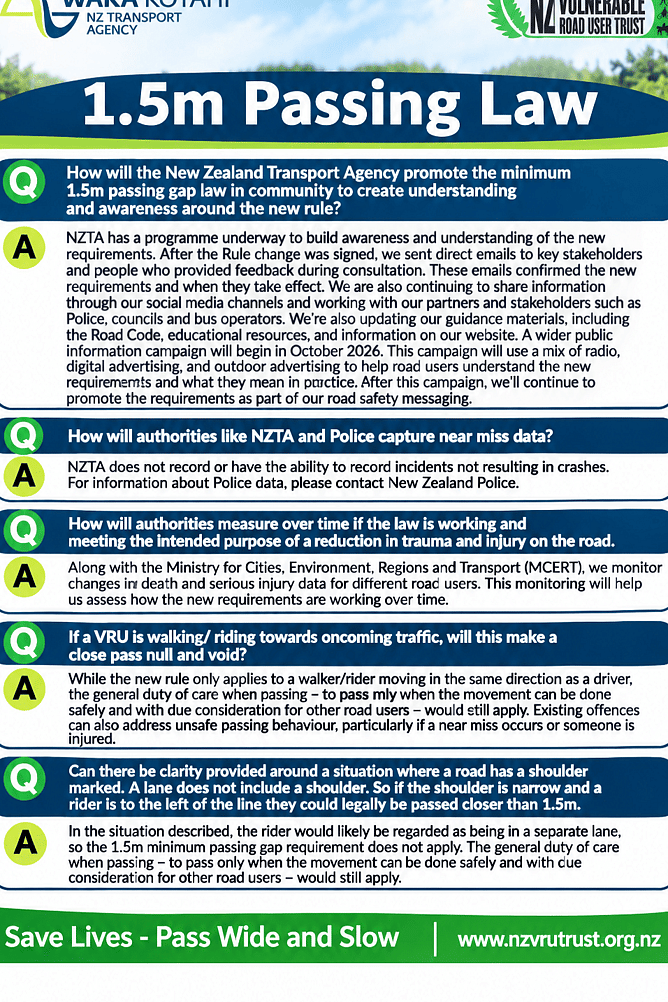
Questions to NZTA in large text form
How will the New Zealand Transport Agency promote the minimum 1.5m passing gap law in community to create understanding and awareness around the new rule? NZTA has a programme underway to build awareness and understanding of the new requirements.
After the Rule change was signed, we sent direct emails to key stakeholders and people who provided feedback during consultation. These emails confirmed the new requirements and when they take effect. We are also continuing to share information through our social media channels and working with our partners and stakeholders such as Police, councils and bus operators.
We’re also updating our guidance materials, including the Road Code, educational resources, and information on our website.
A wider public information campaign will begin in October 2026. This campaign will use a mix of radio, digital advertising, and outdoor advertising to help road users understand the new requirements and what they mean in practice. After this campaign, we’ll continue to promote the requirements as part of our road safety messaging.
How will authorities like NZTA and Police capture near miss data? NZTA does not record or have the ability to record incidents not resulting in crashes. For information about Police data, please contact New Zealand Police.
How will authorities measure over time if the law is working and meeting the intended purpose of a reduction in trauma and injury on the road. Along with the Ministry for Cities, Environment, Regions and Transport (MCERT), we monitor changes in death and serious injury data for different road users. This monitoring will help us assess how the new requirements are working over time.
If a VRU is walking/ riding towards oncoming traffic, will this make a close pass null and void? While the new rule only applies to a walker/rider moving in the same direction as a driver, the general duty of care when passing – to pass only when the movement can be done safely and with due consideration for other road users – would still apply. Existing offences can also address unsafe passing behaviour, particularly if a near miss occurs or someone is injured.
Can clarity be provided around a situation where a road has a shoulder marked. A lane does not include a shoulder. So if the shoulder is narrow and a rider is to the left of the line they could legally be passed closer than 1.5m. In the situation described, the rider would likely be regarded as being in a separate lane, so the 1.5m minimum passing gap requirement does not apply. The general duty of care when passing – to pass only when the movement can be done safely and with due consideration for other road users – would still apply.
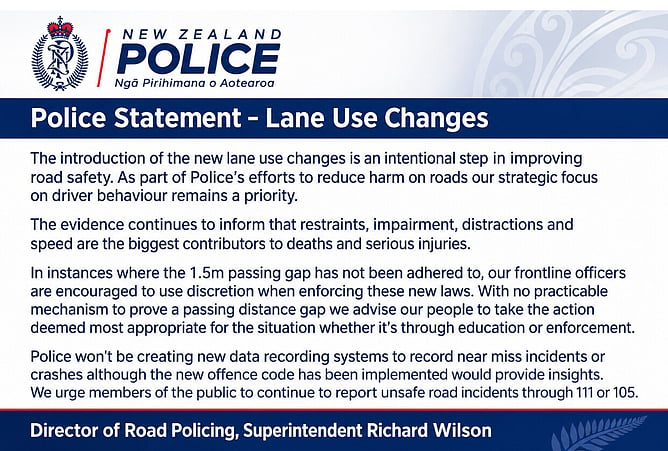
QUESTIONS TO NEW ZEALAND POLICE
Police do not have technical equipment to measure a distance, so what evidence will Police require in order for an infringement to be issued?
Will video footage of an incident be accepted by Police as evidence of a close/ dangerous pass?
Will a specific code be implemented by Police in its reporting system to capture the number of incidents reported? This would obviously make it easier to extract specific data relating to the affected road user groups - pedestrians, cyclists and horse riders.
The NZVRU Trust will continue to seek information and clarity on behalf, in an effort to ensure this Rule Change is implemented to meet its intended purpose.